

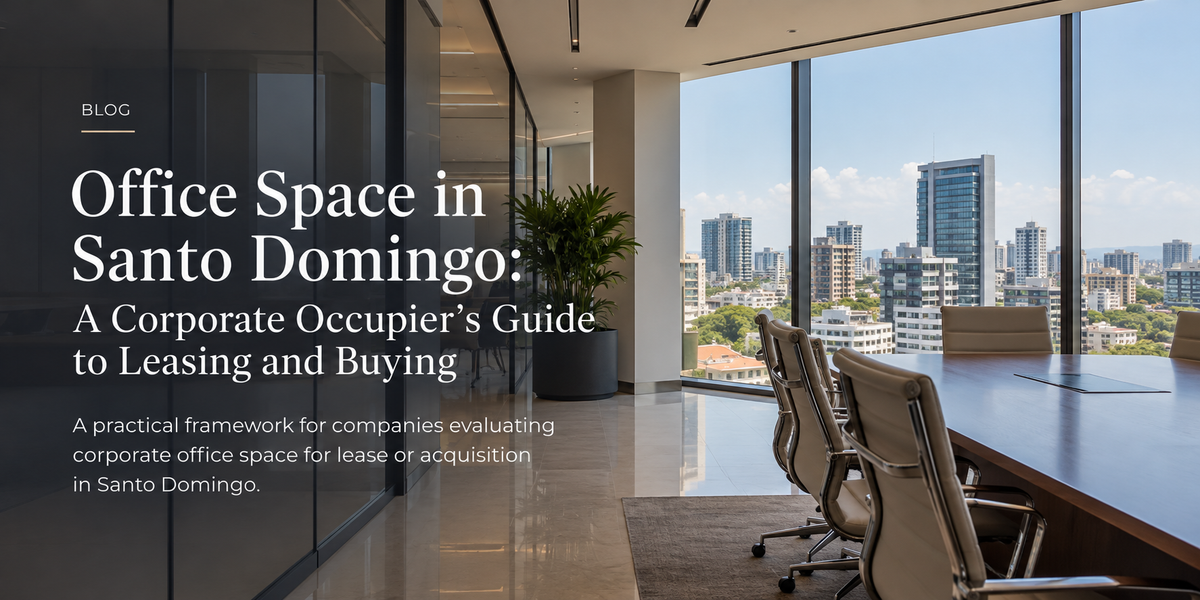
Office Space in Santo Domingo: A Corporate Occupier’s Guide to Leasing and Buying
A request for 500, 1,000 or 3,000 square meters does not tell me enough to recommend an office building.
How many people will work there?
How do they work?
How many parking spaces are actually needed?
Does the company receive clients?
Will the operation require extended hours?
How much growth is expected over the next five years?
Is the company looking for an existing fitted office, or is it prepared to invest in a complete fit-out?
These questions often tell us more about a company’s real estate requirements than the square-meter requirement itself.
In Santo Domingo, selecting the right corporate office space involves much more than comparing locations, rental rates or asking prices. It requires understanding how a property will support the company’s operations, financial objectives and long-term business strategy.
Location Is More Than an Address
Piantini, Naco, Evaristo Morales and Santo Domingo’s principal corporate corridors offer different combinations of accessibility, services, corporate environments and available office inventory.
But a prestigious address should never compensate for an operational mismatch.
For one company, proximity to clients may be critical. For another, employee accessibility may be the determining factor.
Others may prioritize parking availability, visibility, security, amenities or proximity to their executive teams.
A location should be evaluated according to the needs of the business occupying it, not simply its reputation.
The right address is the one that supports the operation.
Parking Can Eliminate an Otherwise Excellent Property
Parking is one of those requirements that can appear secondary during the initial search and become decisive during the evaluation process.
It is not enough to know how many parking spaces a building has.
We need to establish how many spaces are assigned to the premises, whether additional parking can be secured, how visitor parking is managed and whether the available ratio is realistic for the company’s headcount.
A building may offer excellent specifications, competitive rental rates and an attractive location, yet fail to meet the company’s operational requirements because of insufficient parking.
This is precisely why parking should be evaluated early in the process rather than after a property has already been shortlisted.
Shell Space or Fitted Office?
Another important consideration is whether the company should lease or acquire shell space or an existing fitted office.
Shell space offers greater flexibility to design a workplace according to specific operational requirements.
However, it also involves architecture, engineering, permits, construction, furniture, technology, project management and additional capital investment.
An existing fitted office may significantly accelerate occupancy and reduce initial construction requirements.
But the existing layout, electrical infrastructure, air-conditioning systems, technology and workplace configuration may not align with the new operation.
Neither alternative is automatically better.
The decision requires evaluating capital expenditure (CAPEX), implementation timelines and operational readiness alongside the rental or acquisition price.
A difference of a few dollars per square meter can become considerably less important when one alternative requires several additional months before the company can begin operating.
The Real Cost of Occupying an Office
One of the most common mistakes in corporate real estate decisions is comparing properties based primarily on their asking rent per square meter.
The rental rate is only one component of the financial equation.
A proper comparison should consider the total cost of occupancy, including:
* Base rent and contractual increases.
* Common area maintenance and building charges.
* Parking expenses.
* Utilities and operational requirements.
* Initial fit-out and technology investments.
* Furniture and relocation expenses.
* Rent-free periods or other negotiated incentives.
* Time required before the space becomes operational.
For companies comparing multiple alternatives, these variables should be analyzed over a consistent occupancy period.
An office with a lower rental rate may ultimately represent a higher financial commitment once the complete operational and capital requirements are considered.
The objective is not simply to identify the lowest asking price.
It is to understand the actual financial impact of occupying each property.
Lease or Buy?
There is no automatic answer to whether a company should lease or purchase its corporate office space in Santo Domingo.
Leasing may provide greater flexibility, preserve capital and allow the company to respond more easily to changing operational requirements.
Acquisition may be appropriate for a long-term occupier seeking greater control over its premises or interested in building a corporate real estate asset.
For a CFO or corporate real estate decision-maker, both alternatives should be evaluated using comparable financial assumptions.
That means considering the initial cash requirement, recurring occupancy expenses, CAPEX, financing costs, flexibility, expected occupancy horizon and opportunity cost of capital.
Ownership also introduces considerations such as property maintenance, capital commitments, liquidity and future resale or leasing potential.
A purchase decision should make sense both as an operational solution and as a capital allocation decision.
The best alternative depends on the company’s business strategy, financial structure and long-term plans.
What Happens in Five Years?
One question I frequently ask corporate occupiers is:
What happens if your company looks different in five years?
Can the office accommodate reasonable growth?
Would the existing configuration support a different operating model?
If the company purchases the property and later needs to relocate, would the asset remain attractive to another occupier?
If it leases, what flexibility exists regarding expansion, renewal, early termination or relocation?
Corporate real estate decisions should address today’s requirements without unnecessarily restricting tomorrow’s options.
Flexibility has value, even when it is difficult to quantify in the initial financial comparison.
Working the Santo Domingo Office Market
Once the corporate requirement is clearly defined, the next step is not simply to circulate every available property with the requested square meters.
The process requires a more disciplined approach.
We identify suitable buildings, verify availability, evaluate operational compatibility and engage with owners, developers and other brokers when necessary.
We assess the alternatives against the company’s priorities, clarify relevant commercial conditions and identify potential limitations before arranging property tours.
For multinational companies and regional corporate real estate teams, this local market intelligence is particularly important.
Decision-makers may be evaluating the Dominican Republic from another country, while local management must eventually implement the operation.
Both perspectives need to be aligned.
The objective is not to produce the longest property list.
It is to develop a qualified shortlist of properties that local teams can evaluate and regional decision-makers can assess with confidence.
That is the difference between simply searching for office space and managing a corporate real estate requirement.
Evaluating Office Space in Santo Domingo?
Whether your company is planning an expansion, relocation, consolidation or acquisition, the starting point should be a clear understanding of its operational and financial requirements.
At Desangles Properties, we work with corporate occupiers evaluating office space for lease or acquisition in Santo Domingo, providing local market knowledge and a structured approach to property selection.
Let’s discuss your requirements and identify the alternatives that make sense for your business.
⸻
Indhira Desangles, SIOR, CIPS
Managing Director
Desangles Properties
Corporate Real Estate Advisor | Dominican Republic


