

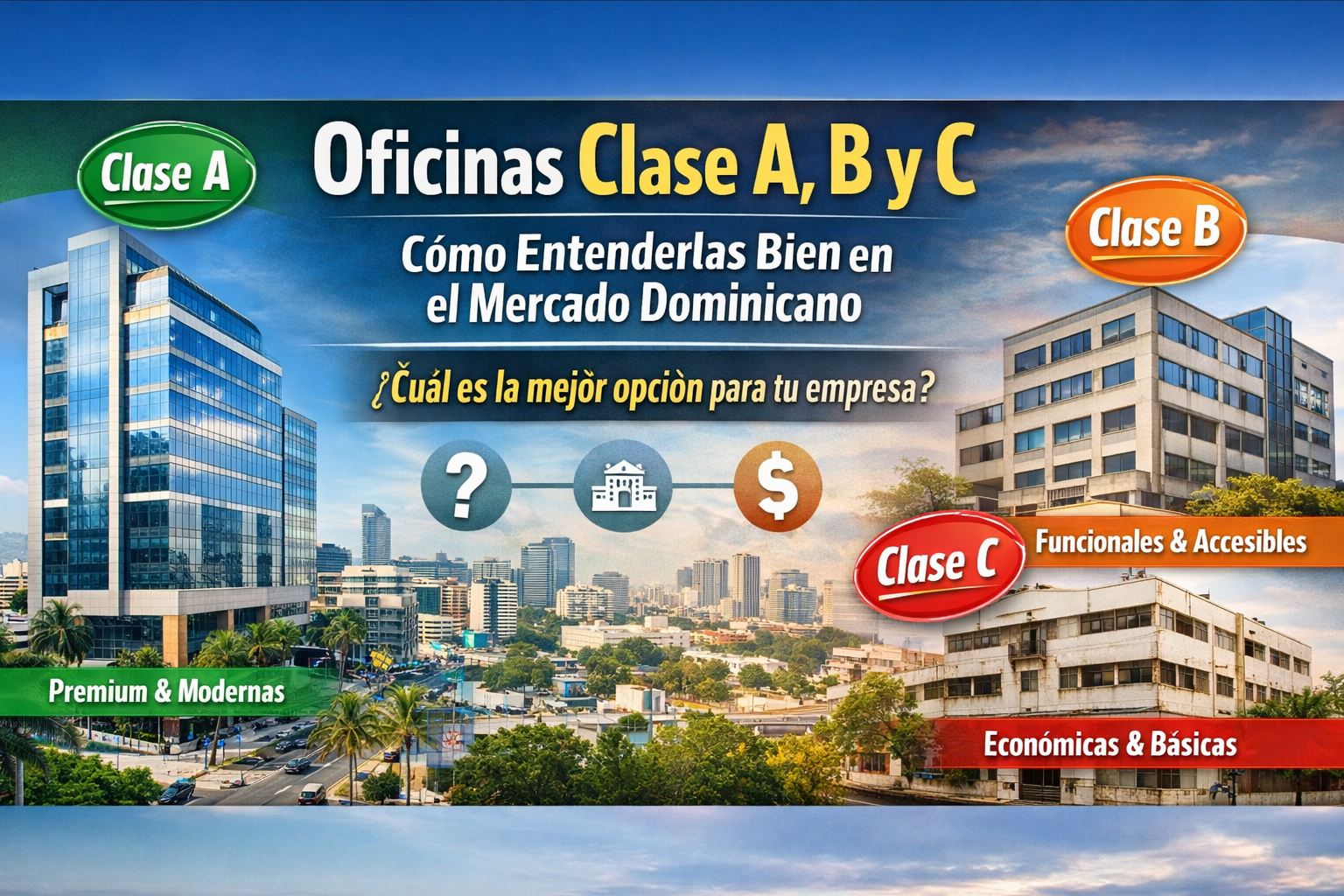
Oficinas Clase A, B y C: Cómo Entenderlas Bien (y Escoger Mejor) en el Mercado Dominicano
En el mercado inmobiliario corporativo dominicano se habla cada vez más de oficinas Clase A, B y C. El problema no es el término.
El problema es que muchas veces se usa sin entender realmente qué significa. Para algunos, Clase A es simplemente “la más nueva”. Para otros, es “la más chula”. Para muchos, es la que está de moda o la que queda en una ubicación premium.
Pero en el mundo inmobiliario institucional —el que manejan inversionistas, fondos y multinacionales— estas clasificaciones tienen un significado mucho más técnico. Y entenderlas bien puede marcar la diferencia entre una buena decisión… y una muy costosa.
¿De dónde salen las Clases A, B y C?
Las clasificaciones Clase A, B y C no nacen en República Dominicana. Son términos utilizados principalmente en mercados institucionales, como Estados Unidos, Europa y otros mercados maduros, para estandarizar la calidad del inventario inmobiliario y facilitar la toma de decisiones de inversionistas y ocupantes corporativos.
Sirven para comparar activos dentro de un mismo mercado, no como etiquetas absolutas, sino relativas al contexto. Y ahí está la primera gran lección: Un Clase A en un país no es necesariamente igual a un Clase A en otro.
Clase A: más que nuevo y bonito
En términos internacionales, una oficina Clase A suele cumplir con varios de estos criterios:
- Edificio relativamente nuevo o recientemente renovado
- Ubicación prime o estratégica
- Altos estándares de construcción
- Sistemas modernos (aires, ascensores, electricidad, data)
- Generadores de respaldo completos
- Estacionamientos adecuados
- Administración profesional
- Amenidades para el usuario
- Cada vez más, certificaciones como LEED o EDGE
En República Dominicana, el término Clase A se ha ido adoptando en la última década, de la mano de desarrolladores más sofisticados, fondos de inversión y grupos empresariales que construyen pensando en rentabilidad a largo plazoy en inquilinos de alto perfil.
Pero localmente, muchas veces se elige Clase A simplemente porque:
- es lo más nuevo
- está en la zona “correcta”
- proyecta estatus
Y no siempre porque sea lo que la empresa realmente necesita.
Clase B: el gran incomprendido
Las oficinas Clase B suelen ser edificios:
- no tan nuevos, pero bien mantenidos
- bien ubicados, aunque no necesariamente prime
- con infraestructura funcional
- con costos más eficientes
- con mayor flexibilidad operativa
En muchos casos, una Clase B bien gestionada funciona mejor que una Clase A mal utilizada.
Para empresas locales en crecimiento, firmas profesionales, back offices o empresas con estructuras más flexibles, una Clase B puede ser una decisión mucho más inteligente en términos de:
- costo total de ocupación
- adecuaciones
- escalabilidad
- retención de talento
El problema es que muchas veces se descarta sin análisis, solo por la etiqueta.
Clase C: no es sinónimo de malo
Las oficinas Clase C suelen ser:
- edificios más antiguos
- de segundo uso
- con infraestructura básica
- en ubicaciones no prime
Pero eso no las hace automáticamente una mala decisión.
En República Dominicana existen muchos espacios Clase C que, con una buena remodelación, mantenimiento y gestión, pueden convertirse en oficinas dignas, funcionales y eficientes, especialmente para:
- empresas pequeñas y medianas
- operaciones internas
- negocios que priorizan costo y ubicación funcional
Aquí aplica una verdad clave:
No todo lo que no es Clase A está mal, ni todo lo que es Clase A está bien para todos.
Contexto dominicano: entender de dónde venimos
Hace apenas una década, en República Dominicana no existía un mercado desarrollado de edificios corporativos pensados para renta o venta como hoy.
La mayoría de los edificios emblemáticos eran:
- sedes propias de bancos
- aseguradoras
- constructoras
- empresas familiares
- grupos locales que construían para uso propio
Sí existían edificios empresariales pequeños y medianos, pero el concepto de inventario corporativo institucional es relativamente reciente.
Por eso hoy estamos en un proceso de aprendizaje y maduración como mercado.
¿Cómo “aplatanar” estas clasificaciones?
Entender Clase A, B y C en República Dominicana implica adaptarlas a nuestra realidad:
- a nuestros tamaños de mercado
- a nuestros presupuestos
- a nuestra cultura empresarial
- a nuestras dinámicas de transporte y talento
La pregunta correcta no es: “¿Puedo pagar una Clase A?”
La pregunta correcta es:
- ¿Qué necesita mi empresa hoy?
- ¿Cómo crecerá en los próximos 3–5 años?
- ¿Qué impacto tiene este espacio en mi equipo?
- ¿Cuál es el costo total, no solo la renta?
Escoger bien es madurez empresarial
Elegir una oficina no es una decisión estética. Es una decisión de negocio. Las empresas que escogen bien no buscan etiquetas. Buscan funcionalidad, eficiencia y coherencia con su etapa de crecimiento.
Porque una buena oficina no es la más cara ni la más nueva.
Es la que mejor funciona para el negocio que la habita.
_____
Class A, B, and C Offices: How to Understand Them Properly (and Choose Better) in the Dominican Market
In the Dominican corporate real estate market, there is increasing talk about Class A, B, and C office buildings. The problem is not the terminology itself.
The problem is that it is often used without truly understanding what it means.
For some, Class A simply means “the newest.”
For others, it means “the nicest-looking.”
For many, it is the building that is trendy or located in a premium area.
However, in the institutional real estate world—the one operated by investors, funds, and multinational companies—these classifications carry a much more technical meaning. Understanding them properly can make the difference between a sound decision and a very costly one.
Where do Class A, B, and C come from?
Class A, B, and C classifications did not originate in the Dominican Republic. They are terms primarily used in institutional markets such as the United States, Europe, and other mature markets to standardize the quality of real estate inventory and facilitate decision-making for investors and corporate occupiers.
They are designed to compare assets within the same market—not as absolute labels, but as context-driven benchmarks. And this leads to the first key lesson:
A Class A building in one country is not necessarily a Class A building in another.
Class A: more than new and attractive
Internationally, a Class A office building typically meets several of the following criteria:
-
Relatively new or recently renovated building
-
Prime or strategic location
-
High construction standards
-
Modern systems (HVAC, elevators, electrical and data infrastructure)
-
Full backup power generation
-
Adequate parking ratios
-
Professional property management
-
User-focused amenities
-
Increasingly, certifications such as LEED or EDGE
In the Dominican Republic, the Class A concept has gained traction over the past decade, driven by more sophisticated developers, investment funds, and corporate groups building with long-term returns and high-profile tenants in mind.
Locally, however, Class A is often chosen simply because:
-
it is the newest
-
it is in the “right” area
-
it projects status
Not necessarily because it is what the company truly needs.
Class B: the misunderstood category
Class B offices are typically buildings that are:
-
not brand new, but well maintained
-
well located, though not necessarily prime
-
functionally equipped
-
more cost-efficient
-
operationally flexible
In many cases, a well-managed Class B building performs better than a poorly utilized Class A property.
For growing local companies, professional firms, back-office operations, or businesses with flexible structures, Class B can be a far smarter decision in terms of:
-
total occupancy cost
-
fit-out requirements
-
scalability
-
talent retention
The issue is that it is often dismissed without proper analysis—simply because of the label.
Class C: not synonymous with “bad”
Class C offices are usually:
-
older buildings
-
second-generation spaces
-
basic infrastructure
-
non-prime locations
But that does not automatically make them a poor choice.
In the Dominican Republic, there are many Class C properties that—with proper renovation, maintenance, and management—can become functional, efficient, and perfectly suitable offices, especially for:
-
small and mid-sized companies
-
internal operations
-
businesses prioritizing cost control and functional location
One key truth applies here:
Not everything that is not Class A is bad, and not everything that is Class A is right for everyone.
Dominican context: understanding where we come from
Just a decade ago, the Dominican Republic did not have a developed market of corporate buildings designed specifically for lease or sale as we do today.
Most landmark buildings were:
-
bank headquarters
-
insurance companies
-
construction firms
-
family-owned businesses
-
local groups building for their own use
While small and mid-sized office buildings existed, the concept of an institutional-grade corporate inventory is relatively recent. As a result, the market is still learning and maturing.
How to localize these classifications
Understanding Class A, B, and C in the Dominican Republic requires adapting them to our reality:
-
market size
-
budgets
-
business culture
-
transportation patterns and talent dynamics
The right question is not:
“Can I afford a Class A office?”
The right questions are:
-
What does my company need today?
-
How will it grow over the next 3–5 years?
-
What impact will this space have on my team?
-
What is the total cost—not just the rent?
Choosing well is a sign of business maturity
Selecting an office is not an aesthetic decision. It is a business decision.
Companies that choose well do not chase labels. They prioritize functionality, efficiency, and alignment with their stage of growth.
Because a good office is not the most expensive or the newest one.
It is the one that works best for the business that occupies it.


